


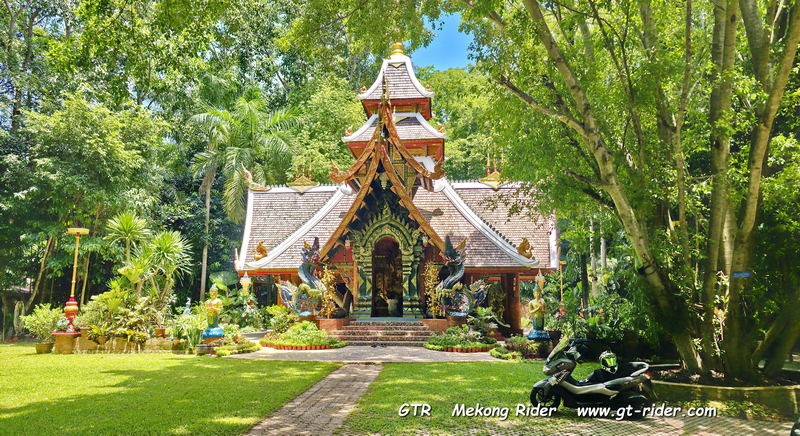
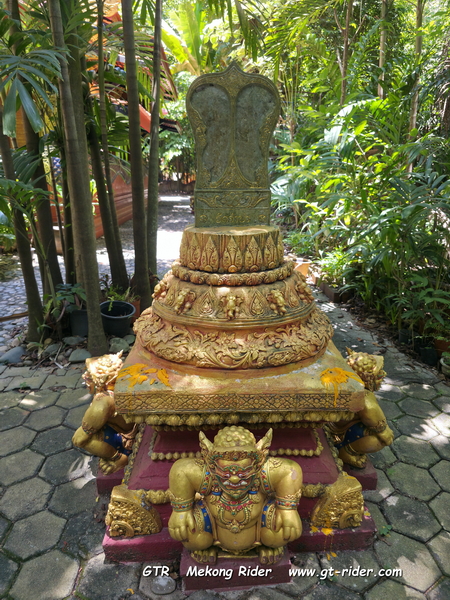
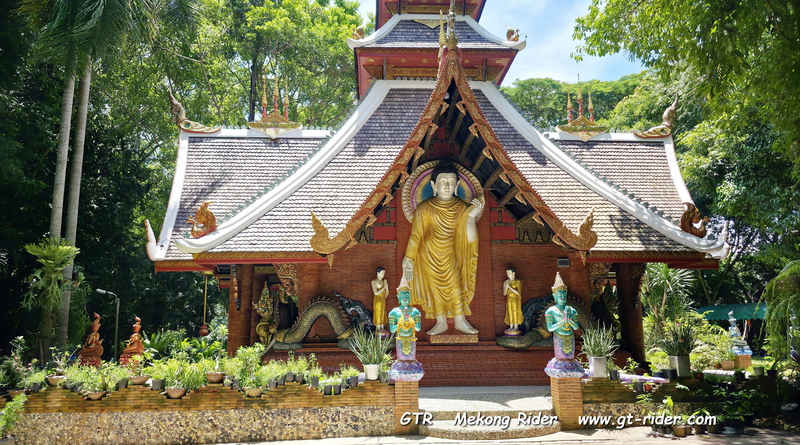
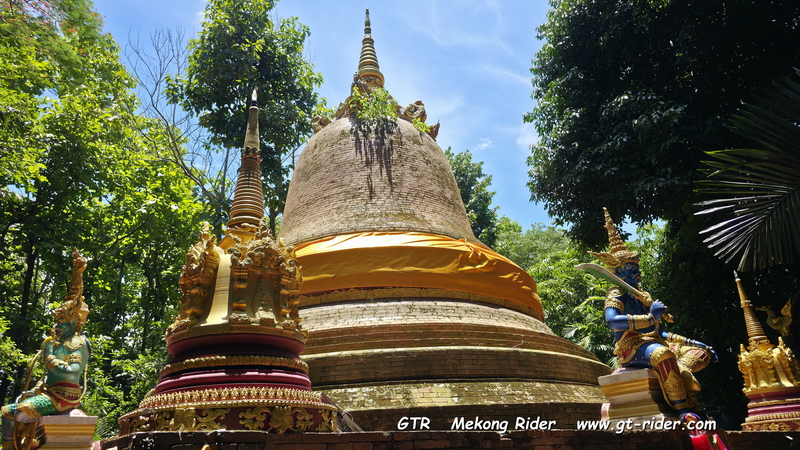
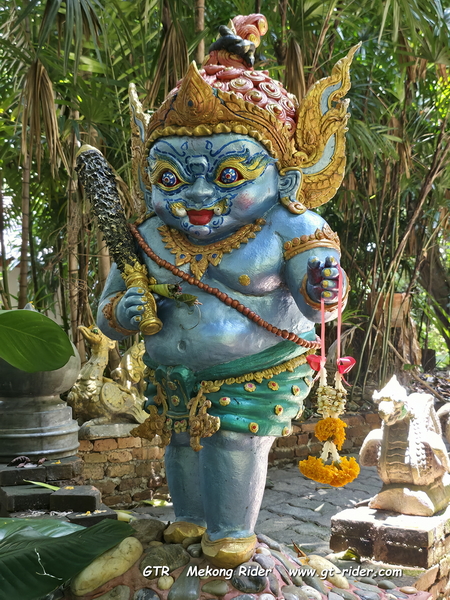
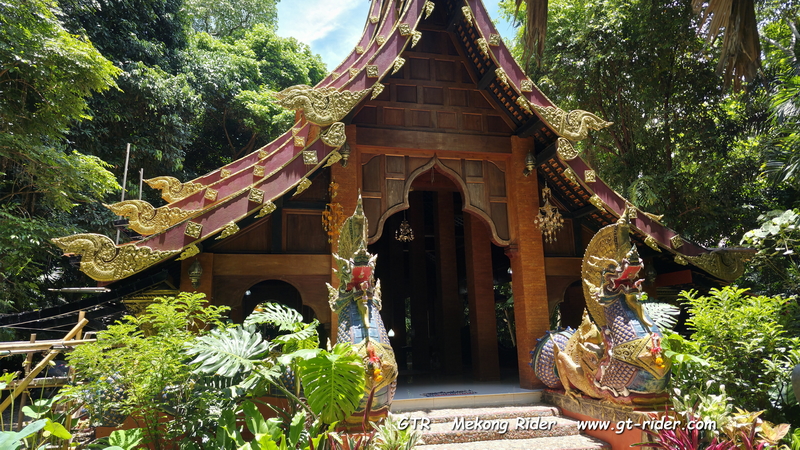
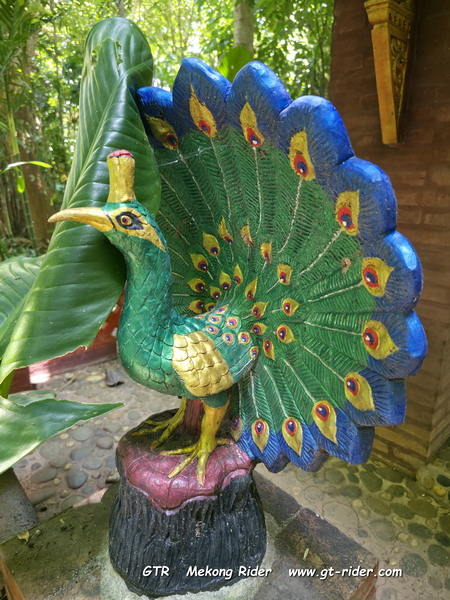
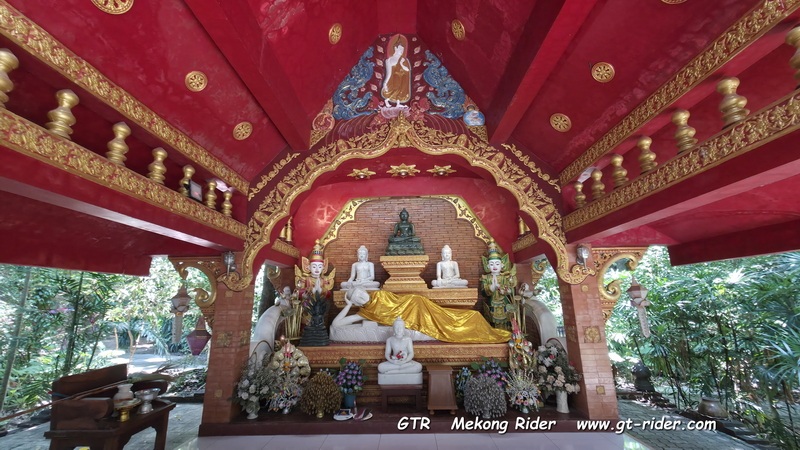
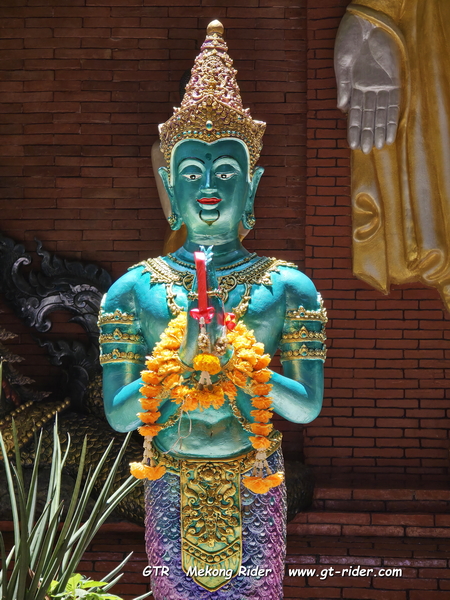
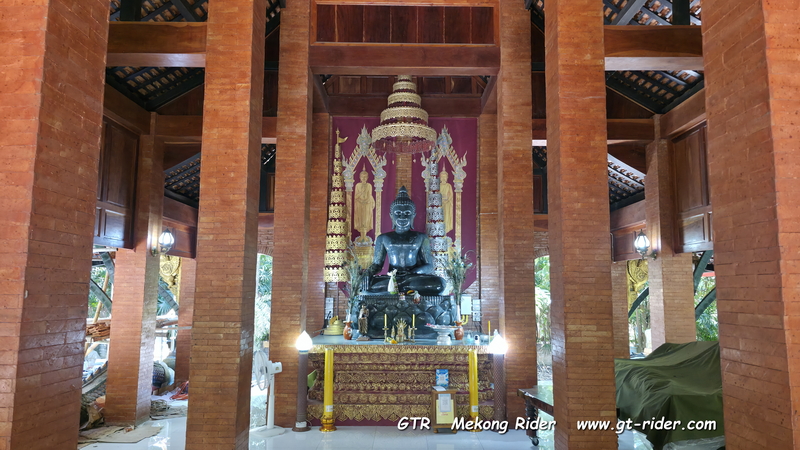
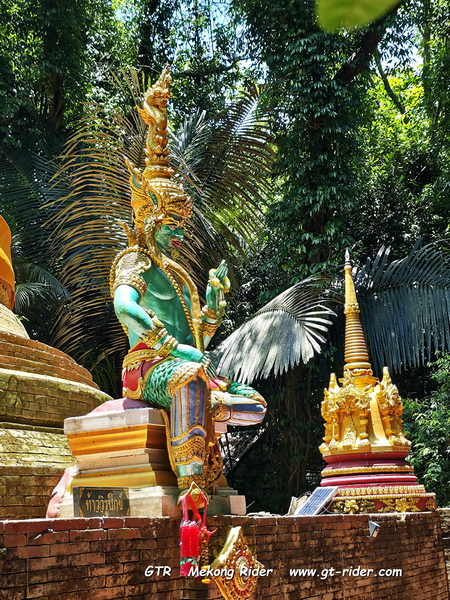
Wat Champa, Don Mahawan, Chiang Khong.
Some Chiang Khong history.
Some history I recently stumbled across: a story of the two cities of Chiang Khong sparked my curiosity and inspired me to spend several days researching a side of Chiang Khong I had never really known or understood.
The Two Chiang Khong cities.
A recent translation of some texts by French experts held at a temple in Luang Prabang indicates that over time there have been two Chiang Khong cities.
The first original Chiang Khong town was at Don Mahawan near the FB4, & then the second Chiang Khong city was at Had Krai.
This first CK city was located next to "Pak Ing", or the point where the Ing River flows to meet the Mekong River.
9 abandoned temples have been identified.
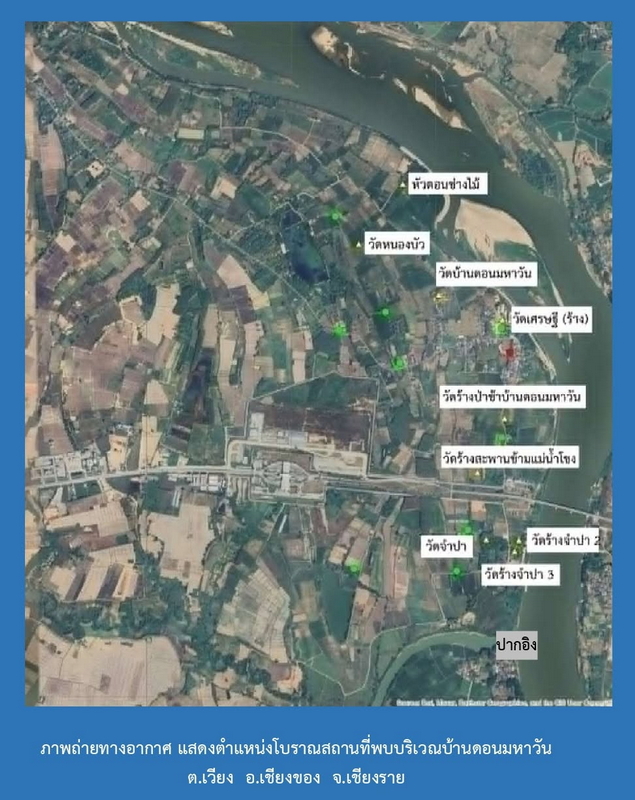
Four of the abandoned temples still have evidence of a large group of archaeological sites.
These wats are Ban Don Mahawan, Wat Setti, Ku Hua Don Carpenter and Wat Champa.
Wat Champa became a temple with monks again during Lent in 2012(?)
It seems as if the early rulers of Chiang Khong originated from Laos.
Nobles, who got caught up in competition between the ruling states, principalities, or kingdoms Luang Prabang, Nan and Siam.
Wiang Kaen
Wiang Kaen may have even been a more important town than Chiang Khong once upon a time but lost a war with Nan.
The residents of Wiang Kaen either fled (to the Chiang Khong area?) or were hauled off to Nan as POWs / slaves.
(A Walk In The Park - Wiang Kaen - Muang Yai Old Town)
Chiang Khong was once part of & ruled from Phayao under King Khamdaeng.
In 1338, it reverted to Chiang Rai control under King Khamfu of Chiang Saen after a battle for the spoils of the North in Fang with King Phanong, a founding ruler from Nan.
Chiang Khong was moved to Ban Haad Krai in 1513?
The 2nd Chiang Khong city was annexed by King Ya Mengrai in 1812.
Chiang Khong has always been an important trading centre for centuries due to the competing influences of the region: Thai, Shan, Lao, and French.
The French & the Shan in Chiang Khong.
After the failed Shan rebellion that started in Phrae in 1902, many Shan fled to the north at Chiang Saen and Chiang Khong.
(Trouble in Phrae – The Shan Rebellion of 1902)
Competing for territory, in 1893 the French forced Siam to accept the Franco-Siamese Reserved Zone (Zone Réservée) treaty after some French gunboats sailed up the Chao Phraya.
Siam ceded all territory east of the Mekong to France.
In addition, France insisted that Siam not station military forces within a strip on the west bank of the Mekong.
This buffer strip existed from 1893 until 1904 and extended approximately 25 kilometres inland from the west bank of the Mekong.
It included Chiang Saen, Chiang Khong and numerous villages between them.
It had a profound effect on frontier towns such as Chiang Saen and Chiang Khong.
Although these places remained Siamese territory, Siam could not freely deploy troops or fortified police there.
This significantly weakened Bangkok's authority.
Legally, the hereditary Chao Mueang (local ruler) remained in office.
Siamese civil officials continued to administer the towns, and taxes were still collected for Siam.
In practice, French commercial agents operated in Chiang Saen and Chiang Khong. They crossed the Mekong frequently, and local chiefs often had to negotiate with both Siamese and French authorities.
The result was a system of dual influence, even though sovereignty formally remained Siamese.
After the failed Shan rebellion that started in Phrae in 1902, many Shan fled to the north at Chiang Saen and Chiang Khong.
(Trouble in Phrae – The Shan Rebellion of 1902)
Between October and November 1902, several hundred Shan rebels entered Chiang Khong, one of the principal towns within the Franco-Siamese Reserved Zone. They quickly challenged the authority of the local northern Thai chief, whom they suspected of supporting Siam. A notice was posted on his house threatening him with death and confiscation of his property unless he expelled Siamese officials from the town. The warning also targeted the lone Siamese postal officer, whose presence represented Bangkok's minimal administration within the Reserved Zone. Unable to escape because the roads were occupied by Shan forces, he remained trapped in Chiang Khong.
Having established control, the Shan appealed to the French Commercial Agency for protection, claiming they feared Siamese retaliation and asking France to safeguard them so they could "live in peace".
Throughout 1903, the Shan maintained their occupation.
The chief of Chiang Khong repeatedly complained to the French about thefts of elephants and cattle—including animals belonging to British timber companies—and warned that conflict between the rebels and local residents was becoming inevitable. He urged the French to persuade the Shan to surrender their weapons.
Across the Mekong at Houayxay, French officials reported widespread disorder, gambling, violence and intimidation, prompting many peaceful inhabitants to abandon the area.
When the French commissioner from Mueang Sing in the far north of Laos visited Houei Xai in early 1903 he found a "turbulent population" lacking any effective leadership. "Every night, despite my interdictions, the inhabitants gambled, and bloody fights followed.
At night, the Shan, and even some French, chased women, who would run away terrified into the countryside.
Because of such a situation, the peaceful inhabitants left the area" (Chamberg 1903b).
A market that the French had established the previous October, in order to take advantage of the influx of new inhabitants, had been destroyed (ibid.).
By March 1904, the chief of Chiang Khong could no longer maintain his authority.
Harassed by the rebels, he fled across the Mekong to the French post, where he sought refuge with his followers.
The Shan installed one of their own leaders as chief of Chiang Khong.
By May, French reports described the town as being in "complete anarchy".
Many residents had fled, while several lesser local chiefs allied themselves with the Shan, taking advantage of abandoned property and livestock.
The Reserved Zone created ideal conditions for the rebellion.
Because Siam was prohibited from deploying troops there without French approval, the Shan used Chiang Khong and Chiang Saen as secure bases from which they could launch raids, retreat across the Mekong into French territory, and exploit the uncertainty created by overlapping Siamese and French authority.
Some French officials tolerated this instability, hoping it would weaken Siamese control and strengthen France's position along the frontier.
The situation changed in April 1904 when intelligence indicated the Shan were preparing another attack on Chiang Rai. Siam requested French permission to send troops into the Reserved Zone.
The Governor-General of French Indochina approved the request, and in mid-May Siamese forces, supported by artillery, entered the zone.
Chiang Saen offered determined resistance before falling after two days of fighting, while the Shan abandoned Chiang Khong after only a brief exchange of gunfire, retreating across the Mekong into French Laos and the British Shan States.
Following the occupation, Siam restored the exiled chief of Chiang Khong in a public ceremony featuring portraits of the King and Queen of Siam, symbolising the reassertion of Bangkok's authority.
Chiefs who had collaborated with the Shan were imprisoned, and rumours spread that Chiang Khong and Chiang Saen would soon be incorporated into Siam's modern provincial administration.
The suppression of the rebellion marked the end of the Reserved Zone as a politically ambiguous frontier. French commercial agencies were gradually withdrawn, the Mekong became a clearly defined international boundary, and although France refused to extradite Shan rebels who had sought asylum in Laos, effective Siamese administration was permanently restored to Chiang Khong and Chiang Saen.
Researching also turned up some info on this Tammila.
Chiang Khong & Tammila Guesthouse
The Tammila in Chiang Khong has been a favourite guesthouse of GTR for decades.
The name has always puzzled me. Where does it come from?
According to local folklore, the original inhabitants of the Chiang Khong area were the Tammila people.
They initially practised animist beliefs, worshipping spirits, until the Buddha visited the region and converted them to Buddhism.
Legend tells that during his travels, the Buddha crossed the Mekong River and stayed at Ban Tammila, a settlement on its banks.
There, he taught the Dharma to the Tammila people and instructed them to uphold the Five Precepts (Benjasila).
Before departing, the people asked the Buddha to leave something behind as a reminder of his presence.
In response, he gave them two strands of his hair (kesa), instructing that they be enshrined separately, one to the left and one to the right of the place where he had stayed, each at an equal distance.
It is believed that these sacred relics later became the sites of Buddhist stupas (pagodas).
Wat Luang and Wat Kaew are the two relevant temple chedis in Chiang Khong city.
According to the same tradition, the abandoned settlement of the Tammila people eventually became known as the Hundred Tao House.
But I can't find any more info on a "Hundred Tao House". It could mean a village with 100 houses??
End of the story for now.
There's still a lot missing to fill in the gaps, a few hundred years here and there, but this little bit makes the town of Chiang Khong & immediate areas more interesting. The Wiang Kaen history would also be great to know. I trust some riders are interested.
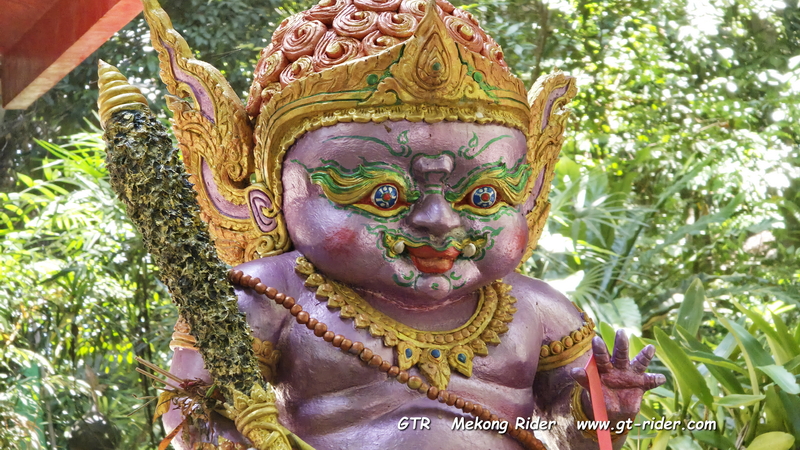
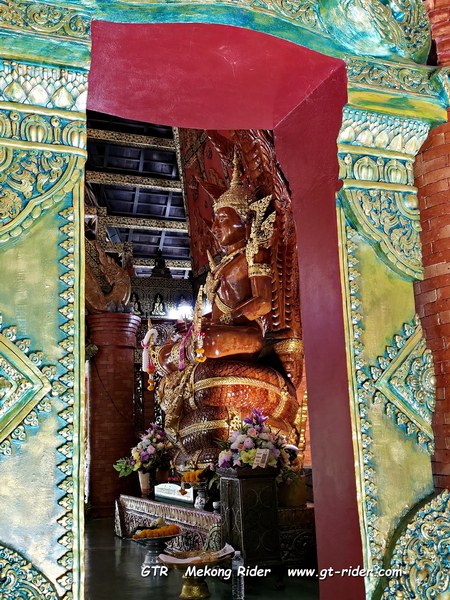
Wat Champa is a gem of a wat to check out in the forest near the Mekong.

 maps.app.goo.gl
References
Ngiao rebellion - Wikipedia
Chaiyasongkhram - Wikipedia
Family tree of Lanna dynasties - Wikipedia
Chiang Khong district - Wikipedia
Trouble in Phrae – The Shan Rebellion of 1902
List of rulers of Lan Na - Wikipedia
Some Chiang Khong history.
Some history I recently stumbled across: a story of the two cities of Chiang Khong sparked my curiosity and inspired me to spend several days researching a side of Chiang Khong I had never really known or understood.
The Two Chiang Khong cities.
A recent translation of some texts by French experts held at a temple in Luang Prabang indicates that over time there have been two Chiang Khong cities.
The first original Chiang Khong town was at Don Mahawan near the FB4, & then the second Chiang Khong city was at Had Krai.
This first CK city was located next to "Pak Ing", or the point where the Ing River flows to meet the Mekong River.
9 abandoned temples have been identified.
Four of the abandoned temples still have evidence of a large group of archaeological sites.
These wats are Ban Don Mahawan, Wat Setti, Ku Hua Don Carpenter and Wat Champa.
Wat Champa became a temple with monks again during Lent in 2012(?)
It seems as if the early rulers of Chiang Khong originated from Laos.
Nobles, who got caught up in competition between the ruling states, principalities, or kingdoms Luang Prabang, Nan and Siam.
Wiang Kaen
Wiang Kaen may have even been a more important town than Chiang Khong once upon a time but lost a war with Nan.
The residents of Wiang Kaen either fled (to the Chiang Khong area?) or were hauled off to Nan as POWs / slaves.
(A Walk In The Park - Wiang Kaen - Muang Yai Old Town)
Chiang Khong was once part of & ruled from Phayao under King Khamdaeng.
In 1338, it reverted to Chiang Rai control under King Khamfu of Chiang Saen after a battle for the spoils of the North in Fang with King Phanong, a founding ruler from Nan.
Chiang Khong was moved to Ban Haad Krai in 1513?
The 2nd Chiang Khong city was annexed by King Ya Mengrai in 1812.
Chiang Khong has always been an important trading centre for centuries due to the competing influences of the region: Thai, Shan, Lao, and French.
The French & the Shan in Chiang Khong.
After the failed Shan rebellion that started in Phrae in 1902, many Shan fled to the north at Chiang Saen and Chiang Khong.
(Trouble in Phrae – The Shan Rebellion of 1902)
Competing for territory, in 1893 the French forced Siam to accept the Franco-Siamese Reserved Zone (Zone Réservée) treaty after some French gunboats sailed up the Chao Phraya.
Siam ceded all territory east of the Mekong to France.
In addition, France insisted that Siam not station military forces within a strip on the west bank of the Mekong.
This buffer strip existed from 1893 until 1904 and extended approximately 25 kilometres inland from the west bank of the Mekong.
It included Chiang Saen, Chiang Khong and numerous villages between them.
It had a profound effect on frontier towns such as Chiang Saen and Chiang Khong.
Although these places remained Siamese territory, Siam could not freely deploy troops or fortified police there.
This significantly weakened Bangkok's authority.
Legally, the hereditary Chao Mueang (local ruler) remained in office.
Siamese civil officials continued to administer the towns, and taxes were still collected for Siam.
In practice, French commercial agents operated in Chiang Saen and Chiang Khong. They crossed the Mekong frequently, and local chiefs often had to negotiate with both Siamese and French authorities.
The result was a system of dual influence, even though sovereignty formally remained Siamese.
After the failed Shan rebellion that started in Phrae in 1902, many Shan fled to the north at Chiang Saen and Chiang Khong.
(Trouble in Phrae – The Shan Rebellion of 1902)
Between October and November 1902, several hundred Shan rebels entered Chiang Khong, one of the principal towns within the Franco-Siamese Reserved Zone. They quickly challenged the authority of the local northern Thai chief, whom they suspected of supporting Siam. A notice was posted on his house threatening him with death and confiscation of his property unless he expelled Siamese officials from the town. The warning also targeted the lone Siamese postal officer, whose presence represented Bangkok's minimal administration within the Reserved Zone. Unable to escape because the roads were occupied by Shan forces, he remained trapped in Chiang Khong.
Having established control, the Shan appealed to the French Commercial Agency for protection, claiming they feared Siamese retaliation and asking France to safeguard them so they could "live in peace".
Throughout 1903, the Shan maintained their occupation.
The chief of Chiang Khong repeatedly complained to the French about thefts of elephants and cattle—including animals belonging to British timber companies—and warned that conflict between the rebels and local residents was becoming inevitable. He urged the French to persuade the Shan to surrender their weapons.
Across the Mekong at Houayxay, French officials reported widespread disorder, gambling, violence and intimidation, prompting many peaceful inhabitants to abandon the area.
When the French commissioner from Mueang Sing in the far north of Laos visited Houei Xai in early 1903 he found a "turbulent population" lacking any effective leadership. "Every night, despite my interdictions, the inhabitants gambled, and bloody fights followed.
At night, the Shan, and even some French, chased women, who would run away terrified into the countryside.
Because of such a situation, the peaceful inhabitants left the area" (Chamberg 1903b).
A market that the French had established the previous October, in order to take advantage of the influx of new inhabitants, had been destroyed (ibid.).
By March 1904, the chief of Chiang Khong could no longer maintain his authority.
Harassed by the rebels, he fled across the Mekong to the French post, where he sought refuge with his followers.
The Shan installed one of their own leaders as chief of Chiang Khong.
By May, French reports described the town as being in "complete anarchy".
Many residents had fled, while several lesser local chiefs allied themselves with the Shan, taking advantage of abandoned property and livestock.
The Reserved Zone created ideal conditions for the rebellion.
Because Siam was prohibited from deploying troops there without French approval, the Shan used Chiang Khong and Chiang Saen as secure bases from which they could launch raids, retreat across the Mekong into French territory, and exploit the uncertainty created by overlapping Siamese and French authority.
Some French officials tolerated this instability, hoping it would weaken Siamese control and strengthen France's position along the frontier.
The situation changed in April 1904 when intelligence indicated the Shan were preparing another attack on Chiang Rai. Siam requested French permission to send troops into the Reserved Zone.
The Governor-General of French Indochina approved the request, and in mid-May Siamese forces, supported by artillery, entered the zone.
Chiang Saen offered determined resistance before falling after two days of fighting, while the Shan abandoned Chiang Khong after only a brief exchange of gunfire, retreating across the Mekong into French Laos and the British Shan States.
Following the occupation, Siam restored the exiled chief of Chiang Khong in a public ceremony featuring portraits of the King and Queen of Siam, symbolising the reassertion of Bangkok's authority.
Chiefs who had collaborated with the Shan were imprisoned, and rumours spread that Chiang Khong and Chiang Saen would soon be incorporated into Siam's modern provincial administration.
The suppression of the rebellion marked the end of the Reserved Zone as a politically ambiguous frontier. French commercial agencies were gradually withdrawn, the Mekong became a clearly defined international boundary, and although France refused to extradite Shan rebels who had sought asylum in Laos, effective Siamese administration was permanently restored to Chiang Khong and Chiang Saen.
Researching also turned up some info on this Tammila.
Chiang Khong & Tammila Guesthouse
The Tammila in Chiang Khong has been a favourite guesthouse of GTR for decades.
The name has always puzzled me. Where does it come from?
According to local folklore, the original inhabitants of the Chiang Khong area were the Tammila people.
They initially practised animist beliefs, worshipping spirits, until the Buddha visited the region and converted them to Buddhism.
Legend tells that during his travels, the Buddha crossed the Mekong River and stayed at Ban Tammila, a settlement on its banks.
There, he taught the Dharma to the Tammila people and instructed them to uphold the Five Precepts (Benjasila).
Before departing, the people asked the Buddha to leave something behind as a reminder of his presence.
In response, he gave them two strands of his hair (kesa), instructing that they be enshrined separately, one to the left and one to the right of the place where he had stayed, each at an equal distance.
It is believed that these sacred relics later became the sites of Buddhist stupas (pagodas).
Wat Luang and Wat Kaew are the two relevant temple chedis in Chiang Khong city.
According to the same tradition, the abandoned settlement of the Tammila people eventually became known as the Hundred Tao House.
But I can't find any more info on a "Hundred Tao House". It could mean a village with 100 houses??
End of the story for now.
There's still a lot missing to fill in the gaps, a few hundred years here and there, but this little bit makes the town of Chiang Khong & immediate areas more interesting. The Wiang Kaen history would also be great to know. I trust some riders are interested.
Wat Champa is a gem of a wat to check out in the forest near the Mekong.
Google Maps
Find local businesses, view maps and get driving directions in Google Maps.
maps.app.goo.gl
References
Ngiao rebellion - Wikipedia
Chaiyasongkhram - Wikipedia
Family tree of Lanna dynasties - Wikipedia
Chiang Khong district - Wikipedia
Trouble in Phrae – The Shan Rebellion of 1902
List of rulers of Lan Na - Wikipedia
Last edited: